
If you’re comparing a concrete pool vs fibreglass pool, there’s one phrase you’ll see everywhere:
“Lifetime structural warranty.”
It sounds impressive.
And it can be.
But before choosing a swimming pool based on the word lifetime, there’s a much more important question to ask:
Lifetime warranty on what, exactly?
A lifetime structural warranty on a fibreglass pool does not necessarily mean the entire installed swimming pool is guaranteed for life.
The warranty may apply specifically to the manufactured fibreglass shell, subject to the individual manufacturer’s definitions, conditions and exclusions.
Installation, ground movement, drainage, groundwater, surface finishes, plumbing, equipment and other components may be dealt with separately.
That distinction matters.
Because when you’re investing tens of thousands of dollars into your backyard, it’s worth understanding exactly what you’re getting — not just the biggest words on the brochure.
What Does a “Lifetime Structural Warranty” Actually Mean?
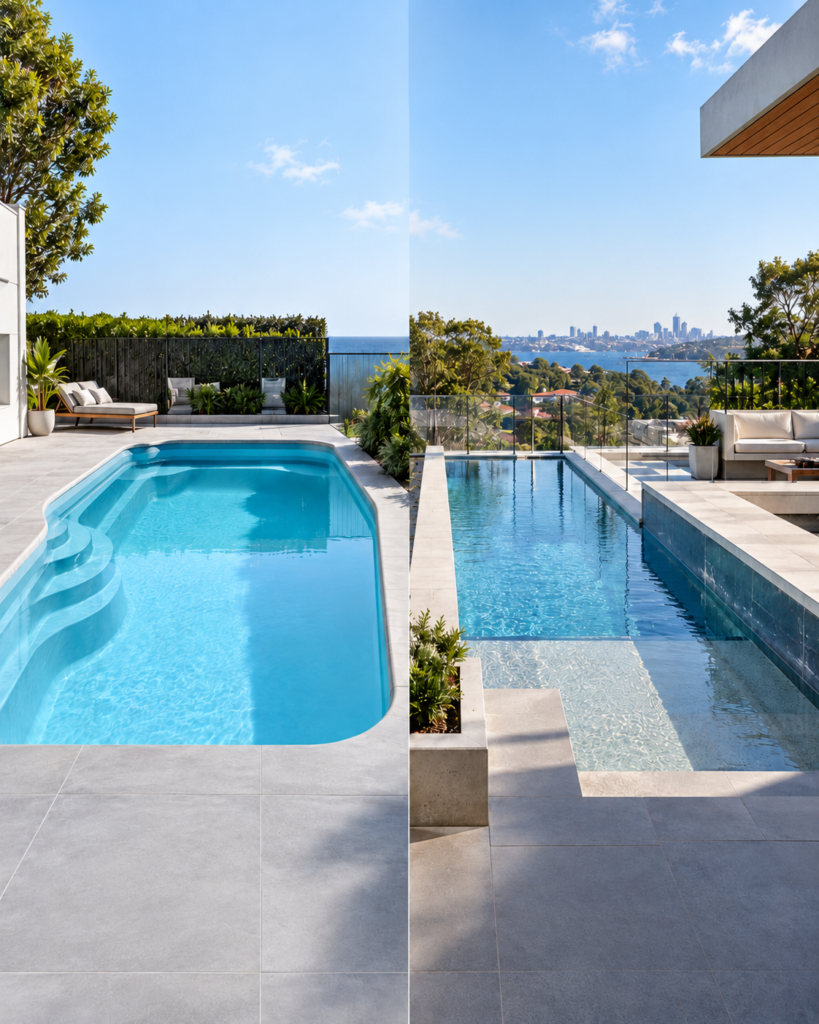
There is no substitute for reading the actual warranty document supplied with the pool.
One of the first things to investigate is how the manufacturer defines the word “structural.”
Does structural mean the shell will never crack?
Does it mean it will never move?
Does it cover ground movement?
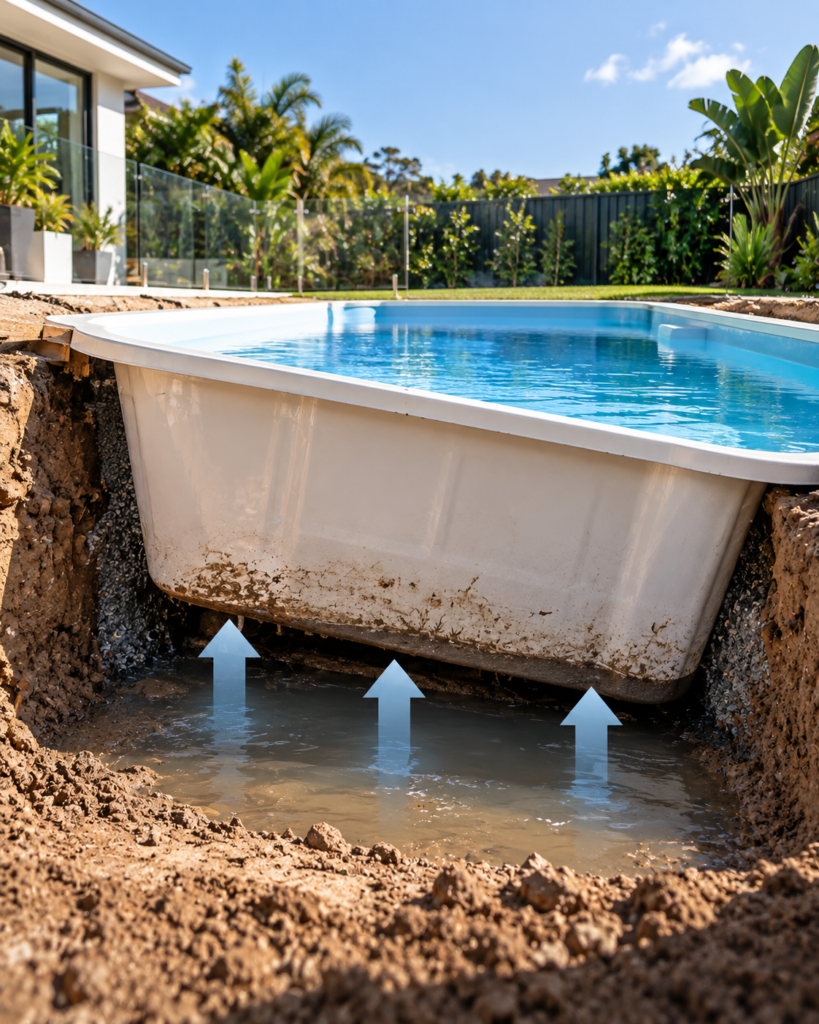
Does it cover the pool lifting due to hydrostatic pressure?
Does it cover the installation?
Or does “structurally sound” essentially mean the shell remains capable of retaining water, subject to specified conditions?
Those are very different promises.
Never assume “lifetime structural warranty” means everything that could structurally go wrong with the completed pool is covered forever.
Ask for the warranty document before signing and read the definitions, conditions and exclusions carefully.
7 Questions to Ask About a Fibreglass Pool Warranty
Before buying a fibreglass pool, ask these questions and, wherever possible, get the answers in writing.
1. Who Actually Provides the Lifetime Warranty?
Is it the pool builder?
The installer?
The fibreglass shell manufacturer?
Or another company altogether?
This matters because the company manufacturing the shell may not be the same business excavating your backyard and installing the pool.
Understanding who is responsible for the warranty — and which part of the project they are responsible for — can make a significant difference if a problem develops later.
2. Does the Lifetime Warranty Cover the Installation?
This is one of the biggest distinctions consumers should understand.
A fibreglass shell can potentially have a long manufacturer warranty while installation workmanship is covered under completely different terms.
If a problem develops, the important question can become:
Did the shell fail — or did something associated with the site or installation cause the problem?
Read the warranty carefully to understand who is responsible for each part of the completed pool.
3. Is Ground Movement Covered?
Your swimming pool doesn’t live in a showroom.
It lives underground.
So ask specifically about:
- soil movement
- settlement
- unstable ground
- groundwater
- drainage
- hydrostatic pressure
- incorrect backfilling
- inadequate bedding
- nearby excavation
- site conditions
If damage caused by one of these circumstances isn’t covered by the shell warranty, the word lifetime suddenly becomes much less important than understanding the installation and site conditions.
4. What Happens If the Pool Lifts or Moves?
Groundwater is an important consideration for any swimming pool.
Ask your fibreglass pool company:
“If groundwater causes my pool shell to move, distort or lift, is that covered by the lifetime structural warranty?”
Don’t settle for a verbal answer.
Ask them to show you where it is addressed in the written warranty.
5. Are Cosmetic Problems Considered Structural?
Not necessarily.
The structural warranty and the surface warranty can be two completely different things.
Ask specifically about:
- fading
- staining
- discolouration
- blistering
- osmosis
- gelcoat deterioration
- surface cracking
- cosmetic imperfections
A pool could potentially remain “structurally sound” under the manufacturer’s definition while experiencing an issue that falls under a different warranty provision.
Understanding the difference between a structural warranty and a surface or cosmetic warranty is important when comparing products.
6. Does the Warranty Transfer When You Sell Your House?
“Lifetime” also raises another obvious question:
Whose lifetime?
Check whether the warranty:
- belongs only to the original purchaser
- transfers automatically to subsequent homeowners
- transfers only for a limited period
- requires registration or approval before transfer
If you’re buying a pool partly to improve your property, warranty transferability is worth understanding from day one.
7. What Maintenance Conditions Apply?
Read the owner’s obligations carefully.
There may be requirements concerning:
- water chemistry
- maintenance
- equipment operation
- pool water levels
- approved repairs
- servicing
- other manufacturer conditions
That’s not necessarily unreasonable — every swimming pool needs proper maintenance.
But you should understand the conditions attached to a warranty before relying on the headline.
The Question That Matters Most: What Happens If Something Goes Wrong?
Here’s the question we’d encourage every pool buyer to ask — regardless of which pool company they’re considering:
“If my pool has a structural problem in 15 years, exactly what costs are covered?”
Not simply:
“Is the shell covered?”
Ask about the complete rectification.
For example, if access to the shell requires removal or reinstatement of surrounding works, ask who is responsible for those associated costs.
Depending on the circumstances and warranty terms, these might include:
- excavation
- pool surrounds
- paving or tiling
- landscaping
- fencing
- plumbing
- equipment
- access
- water removal and replacement
- labour
- reinstatement
The answer should be found in the warranty documentation — not assumed from the word LIFETIME.
How Does This Compare With a Concrete Pool?
Understanding a fibreglass warranty is only one part of comparing pool construction methods.
The other question is how the pool itself is designed, engineered and constructed for the property.
Fibreglass and concrete pools take fundamentally different approaches to swimming pool construction.
Concrete vs Fibreglass: Two Different Construction Approaches
A fibreglass pool begins as a pre-manufactured shell produced in a factory and transported to the property for installation.
A concrete swimming pool is constructed in situ at the property.
At Blue Haven Pools, our concrete pools are designed and constructed as steel-reinforced concrete structures, with engineering appropriate to the pool and project requirements.
You can learn more about how Blue Haven builds concrete pools in NSW.
That creates an important difference:
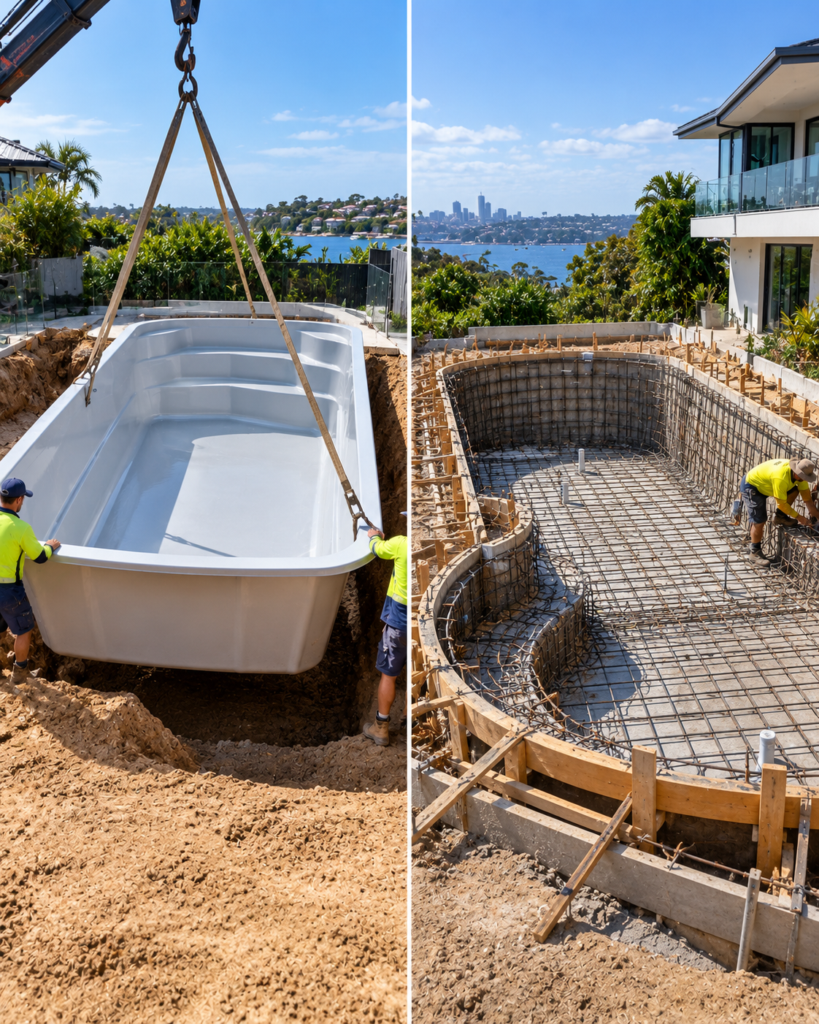
The pool structure can be designed around the property.
You’re not selecting your backyard to suit a mould.
You’re designing the pool to suit your backyard.
Why Homeowners Choose Concrete Pools
For many homeowners, the attraction of concrete isn’t a warranty slogan.
It’s the combination of design flexibility, engineering and long-term adaptability.
1. Concrete Pools Can Be Individually Designed
Want a 7.3-metre pool rather than the closest available mould?
Want different depths?
An integrated spa?
Wet deck?
Beach entry?
Full-width steps?
Ledges?
Swim-outs?
Raised walls?
An infinity edge?
A pool built partially above ground?
A pool designed around a sloping block?
Concrete gives designers considerably more freedom to create the swimming pool around the property rather than selecting from predetermined shell shapes.
Homeowners looking for inspiration can also explore our concrete pool designs for Sydney and NSW backyards.
2. Concrete Can Suit Complex and Difficult Sites
Sydney doesn’t consist entirely of flat, open suburban backyards.
Swimming pool projects can involve:
- sloping blocks
- narrow blocks
- raised sites
- knockdown-rebuild projects
- vacant blocks
- courtyards
- properties requiring retaining solutions
- pools partially or substantially out of ground
For complex properties, site-specific design and engineering become particularly important.
Concrete allows the pool to be considered as part of the individual site rather than simply as a manufactured product being placed into the ground.
For elevated and sloping properties, explore how above-ground concrete pools can work with challenging site levels.
3. A Concrete Pool Can Become Part of the Architecture
A great swimming pool shouldn’t look like something that was simply dropped into the backyard.
It should feel like it belongs with the home and surrounding landscape.
Concrete allows the pool structure, surrounding levels, steps, walls, spa, wet deck and other features to be considered together.
This provides significant flexibility for architectural and highly customised swimming pool projects.
For the right property, the swimming pool can become an integrated part of the overall architectural design.
Explore completed pool projects across Sydney and NSW to see how different pool designs can work with real homes, landscapes and site conditions.

4. Concrete Pools Can Be Renovated Decades Later
Styles change.
Families change.
Technology changes.
And backyards change.
One of the long-term advantages of a concrete swimming pool is its renovation potential.
Depending on the existing structure and proposed works, a concrete pool can potentially be:
- resurfaced
- retiled
- modernised
- upgraded
- incorporated into a larger backyard renovation
- substantially redesigned
An older concrete pool doesn’t necessarily need to continue looking like an older pool.
It can have another chapter.
Blue Haven also provides pool renovations and upgrades in NSW, including structural changes, surface upgrades and new pool features.
Does That Mean Fibreglass Is a Bad Choice?
No.
Fibreglass pools can be an excellent solution for the right homeowner, site and budget.
There are reputable fibreglass manufacturers and pool builders in Australia, and a genuine manufacturer warranty has real value.
The point is much simpler:
Don’t choose between concrete and fibreglass simply because one brochure has the word “LIFETIME” written across it.
Compare what you’re actually buying.
Compare:
Structure.
Engineering.
Installation.
Design flexibility.
Site suitability.
Surface warranty.
Structural warranty.
Workmanship obligations.
Repairability.
Renovation potential.
And exactly what’s covered if something goes wrong.
Then make the decision that suits your property, priorities and budget.
Concrete Pool vs Fibreglass Pool: Which Is Right for You?
There isn’t one swimming pool construction method that is automatically right for every homeowner.
The best choice depends on your property, design expectations, site conditions and priorities.
A fibreglass pool may deserve consideration if you’re comfortable selecting from predetermined shell sizes and shapes and your property is suitable for that type of installation.
A concrete pool may be particularly attractive when the project requires:
- custom dimensions
- custom depths
- architectural integration
- an integrated spa
- raised sections
- wet decks
- infinity edges
- unusual shapes
- complex levels
- sloping sites
- substantial customisation
- future renovation flexibility
For architectural homes, sloping blocks, unusual backyards, raised pools and highly customised designs, concrete provides significant design freedom.
At Blue Haven Pools, we don’t believe the best pool is necessarily the one with the biggest warranty headline.
We believe it should be a pool designed, engineered and built appropriately for the property underneath it.
Before You Buy a Fibreglass Pool, Ask These Five Questions
Before making your decision, ask the salesperson for the full written lifetime structural warranty.
Then ask them to highlight exactly where the document answers these five questions:
1. Does it cover installation?
2. Does it cover ground movement and groundwater?
3. What exactly qualifies as structural failure?
4. What costs are covered if the shell requires major rectification?
5. Does the warranty transfer to the next homeowner?
If you’re satisfied with the answers, great.
If you’re not, keep researching.
Because a swimming pool is a major investment.
Read beyond the word “lifetime.”
Thinking About a Custom Concrete Pool?
Talk to Blue Haven Pools about designing a site-specific concrete swimming pool around your home, backyard and budget.
From compact plunge pools and family pools to raised pools, sloping-block designs, integrated spas and architectural projects, concrete gives us the freedom to design around the property rather than around a factory mould.
If you’re ready to explore what may work for your property, start your pool project with Blue Haven Pools.
BUILD THE POOL FOR THE PROPERTY.
NOT THE PROPERTY AROUND THE POOL.
Blue Haven Pools & Spas
Concrete. Custom. Engineered for your home.